There are discoveries that answer questions… Then there are discoveries that create entirely new ones.
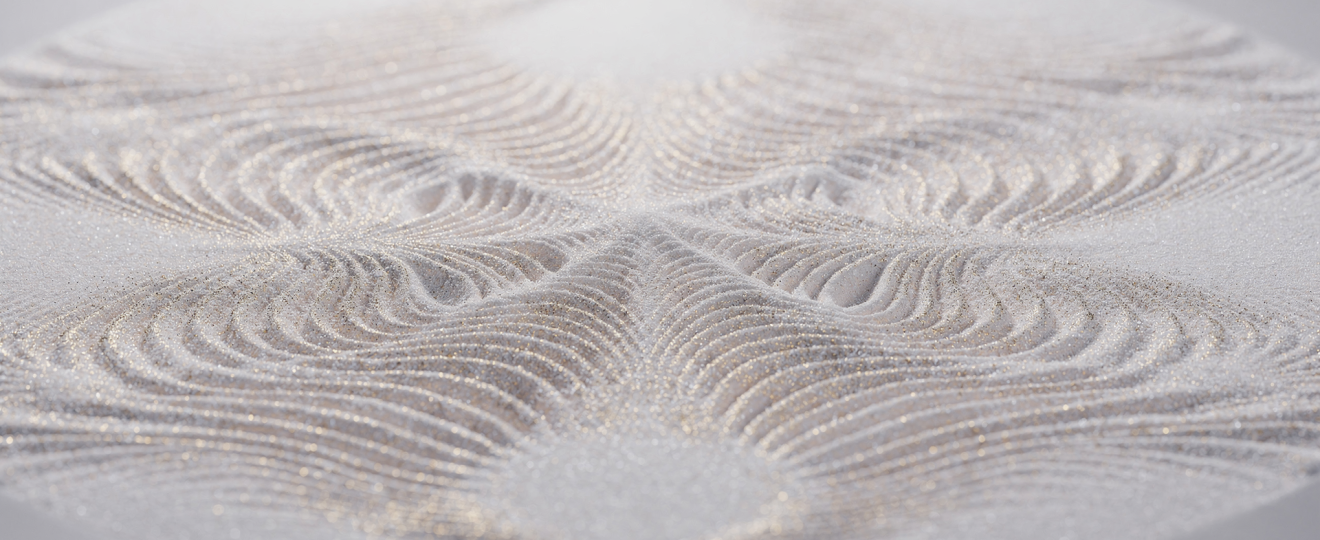
In the late eighteenth century, a German musician and physicist named Ernst Chladni sprinkled sand onto a metal plate, drew a violin bow across its edge, and witnessed something extraordinary. The sand began to move. What started as a random scattering of grains reorganised itself into precise geometric forms: stars, curves, circles, and intricate symmetrical patterns.
For the first time in recorded scientific history, human beings could see sound.
What appeared on those metal plates was more than a curiosity. It was a direct demonstration that vibration leaves structure in its wake. Sound, something normally invisible, was suddenly producing visible order.
A Musician Who Changed Physics
Chladni was not following a grand scientific plan. His interest grew naturally from his background as a musician and his curiosity about how sound behaved within physical objects.
Building on earlier observations made by Robert Hooke in the seventeenth century, Chladni refined the experiment and turned it into a systematic method. His process was remarkably simple.
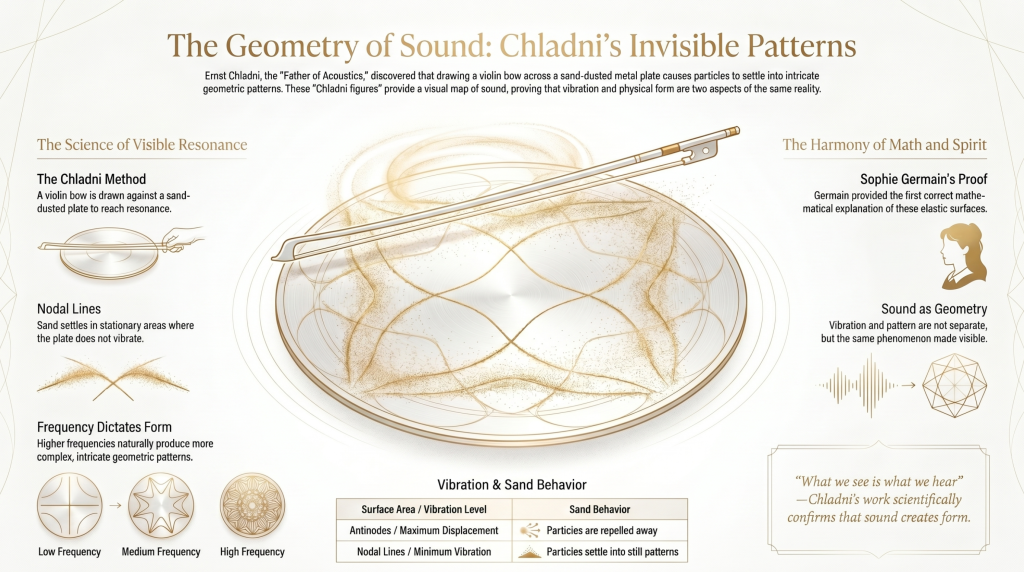
A thin metal plate was covered with fine sand. A violin bow was then drawn across the edge of the plate until it reached resonance. As the plate vibrated, the sand bounced across the surface and gradually collected in areas that remained still.
The resulting patterns were stunning.
Different frequencies created different arrangements. Some produced elegant curves. Others generated complex star-like structures. As the pitch changed, the geometry changed.
The relationship was consistent and repeatable.
Sound was creating form.
In 1787, Chladni published his findings in Discoveries in the Theory of Sound, documenting 166 distinct patterns. His later work, Die Akustik, established him as one of the founders of modern acoustics and earned him the title that remains attached to his name today: the father of acoustics.
Why the Sand Moved
The explanation is surprisingly straightforward.
When a metal plate vibrates, not every part of the surface moves equally. Some areas move intensely while others remain almost completely still.
The areas of intense movement are called antinodes.
The still areas are called nodal lines.
The sand doesn’t gather because sound is attracting it. The opposite is true. Constant vibration pushes the grains away from the active regions until they eventually settle along the stationary nodal lines.
What emerges is effectively a map of the vibration itself.
Every pattern is a visible snapshot of a specific frequency interacting with a physical surface.
Change the frequency and the map changes too.
What Chladni revealed was that sound is not chaotic. It possesses structure. It follows mathematical principles. Given the right medium, those principles become visible.
The Experiment That Captivated Napoleon
Chladni’s demonstrations became famous throughout Europe.
In 1808, he presented his vibrating plates before some of the most influential scientists in France. Among the audience was Napoleon Bonaparte.
Napoleon was fascinated.
The patterns were so striking that he offered a prize of 3,000 francs to anyone who could provide the mathematical explanation for why they formed.
The challenge attracted several attempts, but one mathematician stood out.
Sophie Germain.
Working during a period when women were largely excluded from formal scientific institutions, Germain developed the mathematical framework needed to explain the behaviour of vibrating surfaces. Her work was initially rejected due to errors in presentation, but the foundations of her approach proved correct and eventually became part of the basis for modern elasticity theory.
It is a fascinating historical detail that both the most important mathematical breakthrough and many of the later advances connected to vibration research were driven by women working against the limitations of their era.
More Than an Acoustics Experiment
In Chladni’s lifetime, these patterns were viewed primarily as a breakthrough in acoustic science.
Over the following decades, researchers used them to study musical instruments, vibrating structures, and wave behaviour. Michael Faraday later expanded similar principles into fluid experiments that led to the discovery of what are now known as Faraday waves.
Today, Chladni figures continue to appear in physics laboratories, engineering departments, and acoustics research around the world.
But what makes the experiment so compelling nearly 250 years later is not merely its scientific value.
It is what it demonstrates visually.
A frequency becomes a pattern.
A vibration becomes a shape.
An invisible force produces visible order.
That observation sits at the intersection of physics, mathematics, music, and philosophy.
The pattern is not separate from the vibration.
The pattern is the vibration, expressed in a form the eye can understand.
The Beginning of Cymatics
The word cymatics would not be introduced until almost two centuries later by Swiss researcher Hans Jenny.
Yet the foundations of cymatics were already present in Chladni’s work.
Every modern image of sound creating geometric forms in sand, water, powder, or liquid crystals traces its lineage back to those original metal plates.
Long before high-speed cameras and digital analysis, Chladni had already demonstrated the central principle:
Sound is capable of organising matter into pattern.
That idea continues to inspire scientists, engineers, artists, and sound researchers today.
The Legacy of a Simple Experiment
The equipment was simple.
A metal plate.
A violin bow.
A handful of sand.
Yet the result changed how we understand vibration forever.
Ernst Chladni was searching for a better understanding of sound. What he uncovered was something far more profound: evidence that vibration has structure, and that structure can be seen.
The sand moved.
The patterns appeared.
And for the first time, humanity watched sound draw its own geometry.
Sources
American Physical Society. The First Experiments that Inspired Chladni Figures.
Smithsonian National Museum of American History. Chladni Plates Collection.
Whipple Museum of the History of Science, University of Cambridge. Historical Chladni Specimens.
The Public Domain Review. Chladni Figures (1787).
Encyclopedia.com. Ernst Chladni’s Researches in Acoustics.
National Center for Biotechnology Information (NCBI). Seismology’s Acoustic Debt.