I don’t treat sound as background noise. I treat it as input.
Most people underestimate how aggressively their environment is shaping their internal state. Sound is one of the most direct levers you have, because it bypasses a lot of the cognitive filtering you rely on for everything else. It doesn’t ask for permission. It interacts with your nervous system whether you’re paying attention or not.
That’s where this conversation needs to start: not with hype, but with mechanics.
Sound Is Not Passive — It Enters the System
When you expose yourself to consistent frequencies, you’re not just “listening.” You’re introducing rhythmic patterns that your brain attempts to synchronize with. This is often referred to as entrainment, but stripped of jargon, it’s simple:
Your brain adapts to repeated signals.
Not metaphorically. Physically.
Neural firing patterns begin to align with external rhythms. That’s where changes in focus, calm, or agitation start to show up. Not because something mystical happened, but because the brain prefers coherence over chaos.
The Alpha Range Is Where Control Starts
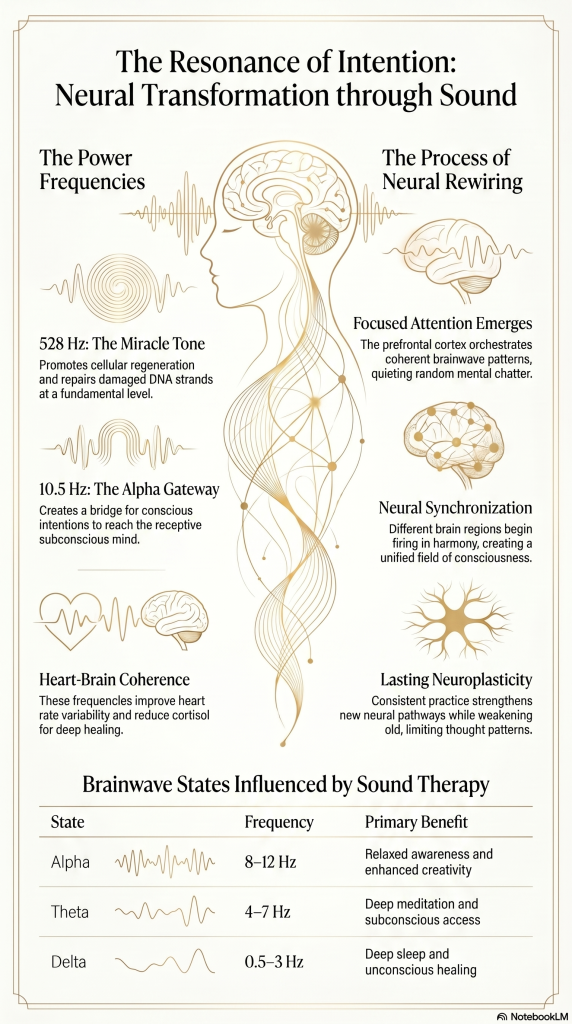
The 8–12 Hz range — commonly associated with alpha brainwaves — is where things get interesting.
This is the state where you’re not asleep, not overstimulated, but highly receptive. Calm, but alert. It’s the mental space where creative thinking, problem-solving, and strategic clarity tend to emerge without friction.
When you consistently expose yourself to sound patterns that encourage this range, you’re not forcing focus. You’re removing resistance to it.
That’s a very different approach.
The Subconscious Isn’t Locked — It’s Filtered
Lower frequencies, like the theta range (4–7 Hz), are often described as a gateway to the subconscious. That language gets overused, but the underlying mechanism is grounded.
In these states, the usual analytical filters of the prefrontal cortex loosen. You’re not “losing control” — you’re reducing interference.
That’s why ideas feel more fluid. That’s why internal narratives can shift more easily. The system is still yours, but the noise floor drops.
If you’ve ever had your best insights while half-awake or deeply relaxed, you’ve already experienced this.
About 528 Hz — Separate Signal from Story
Let’s address the one that gets the most attention: 528 Hz.
You’ll see claims about DNA repair and cellular regeneration. Some of that language is overstated. There isn’t solid, repeatable evidence confirming those specific biological effects at the level people claim.
What is true is this: certain tonal ranges can influence perceived calm, emotional state, and physiological responses like heart rate variability. That matters.
You don’t need exaggerated claims to justify using sound intentionally. The measurable effects on stress, focus, and coherence are already enough.
Coherence Is the Goal — Not Escape
When your brain is fragmented, everything feels harder than it should. Decision-making slows down. Attention fractures. You drift.
Coherent brain activity — where different regions are firing in more synchronized patterns — is where performance improves. Not just productivity, but clarity of thought.
Sound can support that process.
Not instantly. Not magically. But reliably, if used with consistency.
Neuroplasticity Doesn’t Care About Your Intent — Only Your Repetition
This is where most people get it wrong.
They expect one session to “shift” something meaningful. That’s not how the brain works.
Neuroplasticity is driven by repetition and reinforcement. If you pair focused states with consistent auditory input over time, you begin to strengthen those pathways. The brain starts recognizing that pattern as familiar, then preferred.
You’re not just changing how you feel in the moment. You’re training the system.
Heart–Brain Alignment Isn’t Abstract — It’s Measurable
When your nervous system is regulated, your heart rate variability improves. Your breathing stabilizes. Your cognitive load drops.
Sound can support this alignment by reducing stress responses and encouraging more stable internal rhythms.
Again, this isn’t about chasing a feeling. It’s about creating conditions where your system functions cleanly.
Use It Like a Tool, Not a Belief System
You don’t need to buy into every claim to use sound effectively.
Start simple:
- Choose a frequency range aligned with the state you want (focus, calm, depth)
- Use it consistently during specific activities (work, reflection, planning)
- Pay attention to what actually changes — not what you expect to change
Treat it like any other performance input.
Because that’s what it is.
Most people are trying to think their way into better states while ignoring the inputs shaping their brain in the first place.
Sound is one of the few variables you can control immediately.
Use it deliberately, and you’re not just changing what you hear.
You’re changing how you operate.